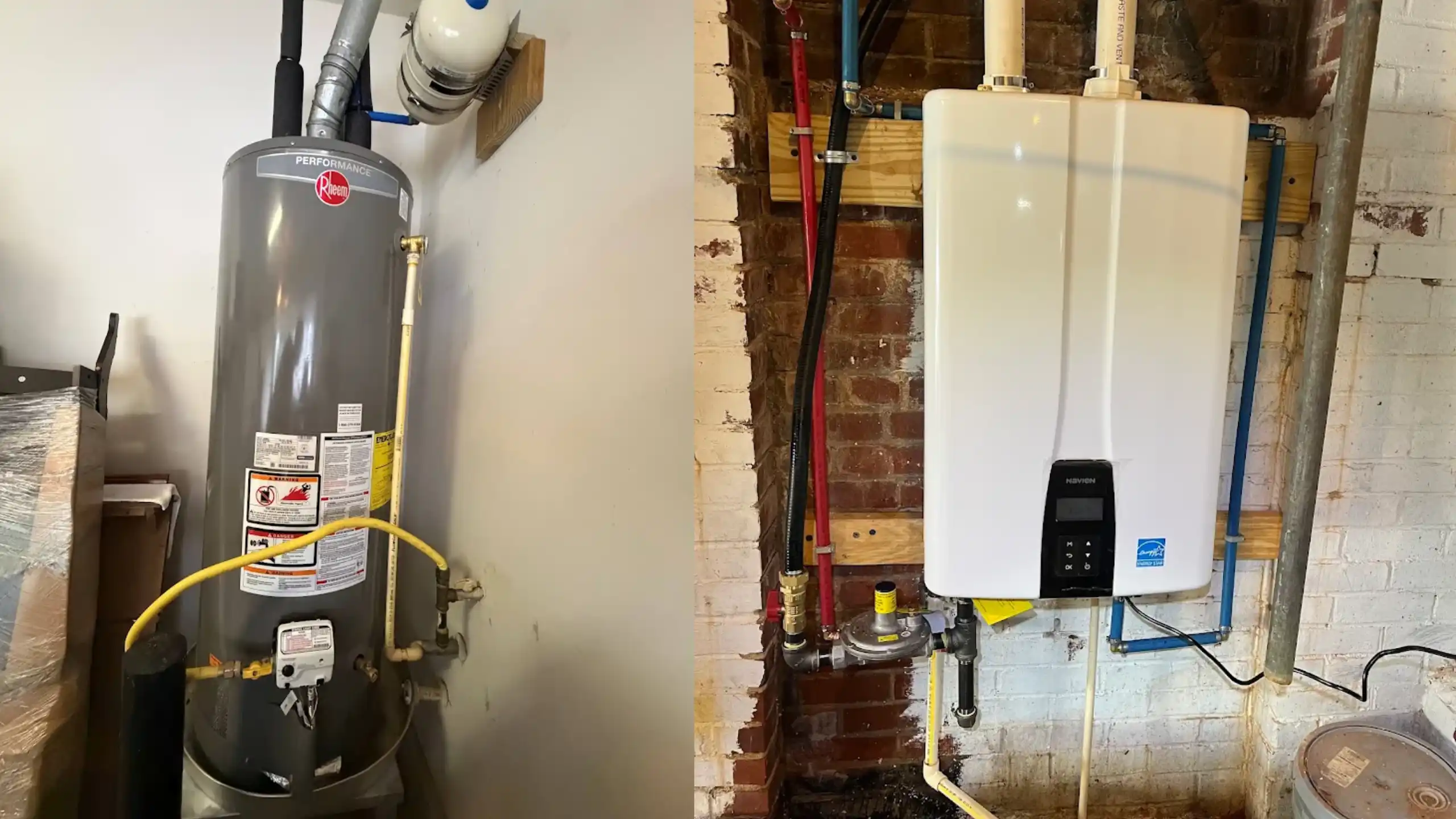
TL;DR: Tank water heaters cost less upfront and are simpler to install. Tankless water heaters last longer, use less energy, and never run out of hot water — but they cost significantly more to buy and install. The right choice depends on your household size, hot water habits, budget, and whether your home's infrastructure can support a tankless unit without expensive upgrades. Neither option is universally "better."
If your water heater is on its way out — or already gone — one of the first decisions you'll face is whether to replace it with another traditional tank unit or make the switch to tankless.
The internet will tell you tankless is always the upgrade. Tankless manufacturers will show you sleek wall-mounted units and talk about endless hot water. And your neighbor who just installed one will tell you it's the best thing they've ever done.
All of that may be true — for them. But the right water heater for your home depends on how you actually use hot water, what your house can accommodate, and what you're willing to spend. Let's break it down honestly.
How Each System Works
Tank water heaters store and continuously heat a set volume of water — typically 40 to 50 gallons in most Greenville homes. When you turn on the hot tap, heated water flows out of the top of the tank and cold water enters at the bottom to be heated. Once the tank is empty, you wait for it to reheat. That recovery time is usually 30 to 60 minutes depending on the fuel type and tank size.
Tankless water heaters don't store water at all. When you open a hot water tap, cold water flows through a heat exchanger and is heated instantly — on demand. As long as the tap is running, you get hot water. There's no tank to drain and no recovery time.
The core trade-off is right there: a tank gives you a reservoir of ready hot water but can run out. A tankless system never runs out but has limits on how much hot water it can produce at once.
Where Tank Water Heaters Still Win
Tank water heaters have been the standard in American homes for over a century, and there are real reasons they're still the most common choice — especially in the Greenville market.
Lower Upfront Cost
A standard 40- to 50-gallon tank water heater installed in the Greenville area typically runs $800 to $2,500, depending on the brand, fuel type, and any code-required updates. That includes the unit and labor.
A tankless system? $1,500 to $4,000+ installed — and that's assuming your home doesn't need additional work (more on that below).
For homeowners who need a replacement now and want to keep costs down, a quality tank water heater is a solid, proven choice.
Simpler Installation
Replacing a tank water heater with another tank is usually straightforward. The plumbing connections, venting (for gas), and electrical are already in place. Most tank-to-tank replacements can be completed in two to four hours.
Tankless installations in homes that currently have a tank are more involved. Depending on your setup, you might need new gas lines sized for higher BTU output, upgraded electrical panels, new venting, or additional plumbing modifications. These upgrades can add $500 to $2,000+ to the project — costs that aren't always obvious when you're shopping for the unit itself.
Handles Simultaneous Demand Differently
Here's something that surprises a lot of homeowners: a 50-gallon tank can deliver hot water to multiple fixtures at the same time without any drop in performance — as long as there's water in the tank. You can run a shower, a dishwasher, and a sink simultaneously and get full-temperature hot water from all three.
A tankless unit has a maximum flow rate measured in gallons per minute (GPM). Most residential gas tankless units produce 5 to 10 GPM. If the combined demand from your fixtures exceeds that flow rate, the water temperature drops or the unit can't keep up. For a household of four running multiple hot water sources at the same time, this can be a real issue — unless you install multiple tankless units, which adds to the cost.
Where Tankless Takes the Lead
If tank water heaters win on simplicity and upfront cost, tankless systems win on almost everything else — assuming the budget and infrastructure work for your home.
Energy Efficiency
A tank water heater keeps 40 to 50 gallons of water hot around the clock, whether you're using it or not. That's called standby heat loss, and it accounts for a meaningful chunk of your energy bill. Modern tanks are better insulated than they used to be, but the fundamental inefficiency remains.
Tankless systems only use energy when you turn on the tap. The Department of Energy estimates that homes using 41 gallons or less per day can see 24 to 34% energy savings with a tankless system. Larger households still see savings — typically 8 to 14%.
Over the life of the unit, those savings add up. Whether they offset the higher upfront cost depends on your usage and how long you stay in the home.
Longer Lifespan
Tank water heaters typically last 8 to 12 years. Tankless units last 15 to 20 years with proper maintenance. That's nearly double the lifespan — which means you'll likely replace a tank water heater at least once in the time a single tankless unit is still running.
When you factor lifespan into the total cost of ownership, the math starts to shift in tankless's favor — especially if you plan to stay in your home long-term.
Unlimited Hot Water
This is the headline feature. A properly sized tankless water heater will never run out of hot water. It heats water as fast as you use it. For households that regularly drain the tank — back-to-back showers, laundry days, guests staying over — this is a genuine quality-of-life improvement.
Space Savings
A tank water heater takes up a significant footprint — typically a dedicated spot in the garage, basement, or utility closet. Tankless units are roughly the size of a small suitcase and mount on the wall. If you're tight on space or want to reclaim that corner of the garage, tankless frees up real estate.
The Greenville Factor
A few things specific to Greenville-area homes are worth considering:
Soft water is on your side. Greenville's water supply is naturally soft, which means less mineral scaling inside both tank and tankless units compared to areas with hard water. This is good news either way, but it's especially relevant for tankless owners — scaling is one of the main maintenance concerns for tankless systems, and Greenville's water quality makes that less of an issue. You should still descale annually, but you're starting from a better baseline.
Gas availability matters. Many Greenville homes have natural gas service through Piedmont Natural Gas, which makes gas tankless a viable option. But if your home is all-electric — more common in newer construction in Simpsonville, Greer, and some Taylors developments — an electric tankless unit may require a significant electrical panel upgrade. That's a cost worth investigating before committing.
Home age and infrastructure. Older homes in established Greenville neighborhoods — North Main, Augusta Road, Sans Souci, Overbrook — were built around tank water heaters. The gas lines, venting, and electrical are sized for tank systems. Retrofitting for tankless is doable but often costs more in these homes than in new construction that can be designed for tankless from the start.
A Realistic Cost Comparison
Here's an honest side-by-side for the Greenville market:
Tank Water Heater (40–50 gallon, gas or electric)
- Unit + installation: $800 – $2,500
- Annual energy cost: ~$400 – $600
- Expected lifespan: 8 – 12 years
- Maintenance: Annual flush, occasional anode rod replacement
Tankless Water Heater (whole-home, gas)
- Unit + installation: $2,000 – $4,500
- Potential retrofit costs: $500 – $2,000+ (gas line, venting, electrical)
- Annual energy cost: ~$250 – $400
- Expected lifespan: 15 – 20 years
- Maintenance: Annual descaling, filter cleaning
Over a 20-year window, a tankless system often costs less in total when you account for energy savings and the fact that you'd need to buy two tank units in the same period. But that only holds if you stay in the home long enough to recoup the higher upfront investment — typically 6 to 10 years.
If you're planning to sell within a few years, a tank replacement is usually the more practical choice.
Which One Is Right for You?
There's no universal answer here, but there are some clear patterns:
A tank water heater probably makes more sense if:
- Your budget is tight and you need a replacement now
- Your home's infrastructure would require expensive upgrades for tankless
- You're planning to sell in the next few years
- Your household's hot water demand is modest (one to two people, predictable usage)
A tankless water heater probably makes more sense if:
- You plan to stay in your home for 7+ years
- You frequently run out of hot water with your current tank
- You want to reduce your monthly energy costs over time
- Your home already has the gas line capacity and venting for tankless (or you're doing new construction)
- Space is at a premium
Either way, the most important step is talking to a plumber who will give you an honest assessment — not just sell you the most expensive option. The right water heater is the one that fits your household, your home, and your budget.
FAQ
Q: Is a tankless water heater worth it in Greenville, SC? A: It can be — especially if you plan to stay in your home long-term and your infrastructure supports the switch without costly upgrades. Greenville's soft water is an advantage for tankless systems because it reduces scaling. But if you're on a tight budget or your home would need significant retrofitting, a quality tank water heater is still a great choice.
Q: How much does it cost to install a tankless water heater in Greenville? A: A whole-home gas tankless system typically runs $2,000 to $4,500 installed in the Greenville area. Electric tankless units for whole-home use are less common but can range from $1,500 to $2,500 installed. Add $500 to $2,000+ if your home needs gas line upgrades, new venting, or electrical panel work.
Q: Can a tankless water heater handle a large family? A: Yes, but sizing matters. A single tankless unit has a maximum flow rate (measured in GPM), and if your family regularly runs multiple hot water fixtures at the same time, you may need a higher-capacity unit or even two units. Your plumber can calculate the right size based on your peak demand.
Q: Do tankless water heaters need maintenance? A: Yes. Annual descaling is recommended to remove any mineral buildup inside the heat exchanger — even with Greenville's soft water. The inline filter should also be cleaned regularly. Skipping maintenance shortens the unit's lifespan and reduces efficiency. (Related: How Often Should You Flush Your Water Heater?)
Q: Will a tankless water heater increase my home's resale value? A: It can be a selling point, but don't overestimate the ROI. Most buyers in the Greenville market care more about a water heater that works reliably than whether it's tankless. A well-maintained tank water heater with years of life left is just as attractive as a tankless unit to most buyers.
Not Sure Which Way to Go? Let's Talk.
The tankless vs. tank decision isn't one-size-fits-all, and the marketing from both sides tends to oversimplify it. The best way to figure out what makes sense for your home is to have a plumber look at your current setup, talk through your hot water habits, and give you real numbers.
Plumbing Heroes serves homeowners across Greenville, Taylors, Greer, Simpsonville, Mauldin, and Travelers Rest. We install both tank and tankless systems and we'll tell you straight which one fits your situation — even if the answer is the less expensive option.
Call us at (864) 313-1289 or schedule a consultation online. No pressure, no runaround — just honest advice.